If you’re reading this, chances are you’ve already published content on your website. Maybe you’ve written dozens of blog posts. Perhaps you’ve hired writers, invested in keyword research tools, and followed every SEO checklist you could find online.
But here’s the million-dollar question: Is that content actually bringing you business?
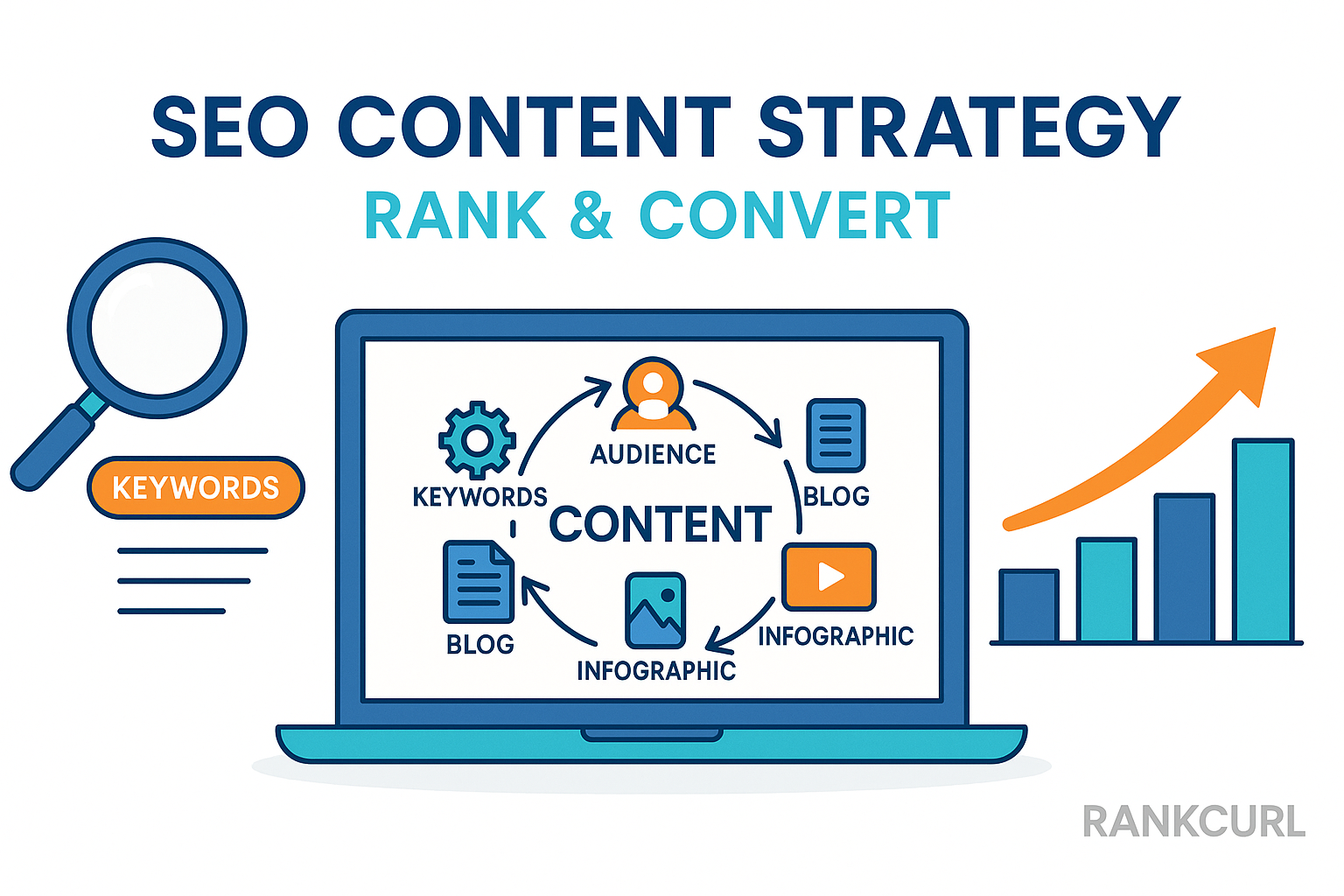
See, ranking on Google is just half the battle. The real magic of a strong SEO Content Strategy happens when your content not only brings visitors but also turns them into leads, customers, and brand advocates. That’s what we call content that ranks and converts.
In 2026, with AI tools flooding the internet with generic content and Google getting smarter about user intent, the game has changed. You can’t just stuff keywords and expect results. You need a proper SEO Content Strategy—one that balances SEO best practices with persuasive, conversion-focused writing.
In this comprehensive guide, I’ll walk you through exactly how to create an SEO content strategy that delivers both traffic and business results. No fluff, just actionable advice you can implement right away.
Why Modern SEO Content Needs to Do Both: Rank and Convert
Let’s get one thing straight: traffic without conversions is just vanity metrics. Sure, it feels good to see thousands of visitors in your Google Analytics, but if those visitors aren’t taking action—signing up, making purchases, requesting demos—then what’s the point?
On the flip side, conversion-optimized content that nobody can find is equally useless. You might have the most persuasive landing page in the world, but without a proper SEO Content Strategy, very few people will ever see it.
Here’s what you need to know:
Recent studies show that 68% of online experiences begin with a search engine, which highlights the importance of SEO. But the average conversion rate for B2B websites is just 2.23%, meaning most visitors leave without converting. This is why a balanced SEO Content Strategy matters.
The brands winning in 2026 are those that have mastered both. They understand search intent, create content that satisfies user needs, build topical authority, and smartly guide visitors toward conversion actions—all without being pushy or salesy.
Let’s dive into how you can do the same.
Step 1: Understanding Your Audience and the Buyer Journey
Before you write a single word, your SEO Content Strategy must clearly define who you’re writing for and where they are in their buying journey.
Build Detailed Buyer Personas
Start by creating 2-3 buyer personas representing your ideal customers. These aren’t just demographic details—dig deeper:
- What are their biggest challenges and pain points?
- What questions are they asking at different stages?
- What objections do they have before making a purchase?
- Where do they hang out online?
- What language and terms do they use?
Pro tip: Pro tip: Interview existing customers. Their real answers directly improve your SEO Content Strategy and conversion rate.
Map Content to the Buyer Journey
An effective SEO Content Strategy uses different content types for different stages:
Awareness Stage: The visitor just realized they have a problem. They’re looking for educational content.
- Blog posts like “What is [problem]?” or “Signs you need [solution]”
- Educational guides and how-to articles
- Industry reports and statistics
Consideration Stage: They understand their problem and are evaluating solutions.
- Comparison articles: “X vs Y: Which is Better?”
- Detailed guides: “Complete Guide to [Solution]”
- Case studies and success stories
Decision Stage: They’re ready to choose a specific product or service.
- Product/service pages
- Free trials, demos, or consultations
- Customer testimonials and reviews
When you align your content with these stages, you naturally increase both relevance (which helps rankings) and conversions (because you’re giving people exactly what they need at that moment).
Step 2: Keyword and Intent Research for 2026
Keywords still matter, but modern SEO Content Strategy starts with intent—not just search volume.
Start with Intent, Not Just Keywords
Google has become incredibly sophisticated at understanding user intent. In fact, with the introduction of Search Generative Experience (SGE) and AI-powered search, intent matching is more critical than ever.
There are four main types of search intent:
- Informational: User wants to learn something (“how to improve website speed”)
- Navigational: User wants to find a specific website (“Ahrefs login”)
- Commercial: User is researching before buying (“best SEO tools for small business”)
- Transactional: User is ready to buy (“buy Ahrefs subscription”)
Each content piece should target one clear intent. This alignment is critical for rankings in 2026.
Use the Right Tools
Here are the tools you should be using in 2026:
- Google Keyword Planner: Free and gives you actual Google data
- Ahrefs or SEMrush: For comprehensive keyword analysis, competition research, and backlink insights
- Answer the Public: Great for finding question-based keywords
- Google’s “People Also Ask” boxes: Goldmine for related questions and topics
- SurferSEO or Clearscope: For content optimization based on top-ranking pages
Analyze the SERP Before You Write
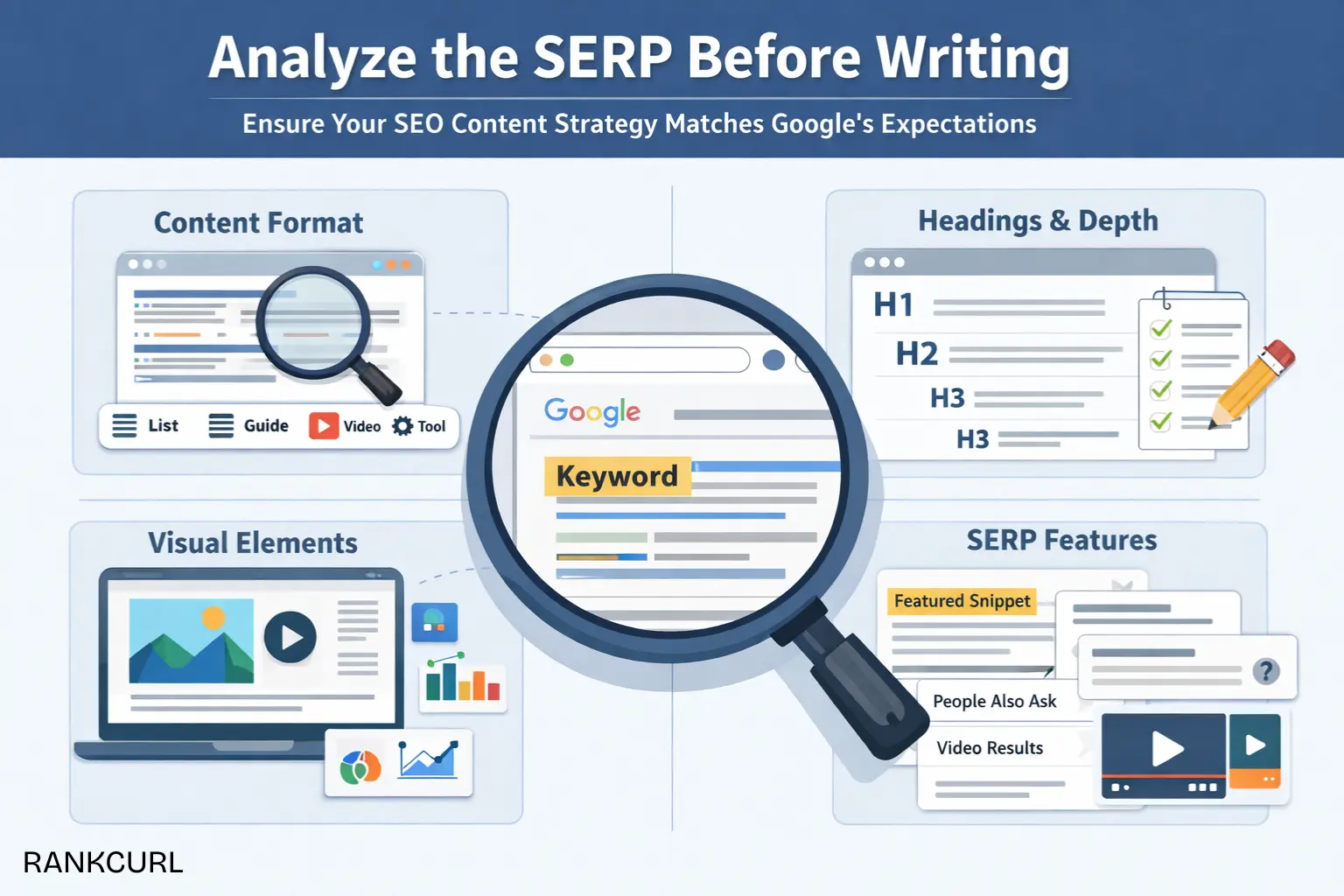
This is crucial: before writing anything, Google your target keyword and study the top 10 results.
Look for:
- What format are they using? (List posts, guides, videos, tools)
- What specific questions are they answering?
- What’s their average word count?
- What visuals are they using?
- What SERP features appear? (Featured snippets, PAA, videos, images)
This SERP analysis tells you exactly what Google considers relevant for that keyword. You need to match or exceed that relevance.
Build Topic Clusters
Instead of targeting random keywords, organize your content into topic clusters:
- Pillar Page: A comprehensive guide on a broad topic (e.g., “Complete Guide to SEO”)
- Cluster Content: Detailed posts on specific subtopics that link back to the pillar (e.g., “Technical SEO Checklist,” “Link Building Strategies,” “Keyword Research Guide”)
This structure establishes topical authority, which Google loves, and makes it easier for users to find related content on your site.
Step 3: Creating Best-in-Class Content Outlines
The outline is where the magic happens. A solid outline ensures your content is comprehensive, logically structured, and covers all important angles.
Conduct a Competitive Gap Analysis
Open the top 5-10 ranking pages for your target keyword. Create a spreadsheet and note:
- All major headings and subheadings they use
- Unique points each one makes
- Questions they answer
- What’s missing or could be improved
Your goal isn’t to copy them—it’s to create something better, more comprehensive, and more unique.
Add Your Unique Angle
Here’s where most content fails: it just rehashes what’s already out there. To stand out:
- Add your personal experience and examples
- Include original data, surveys, or case studies
- Bring in expert quotes or interviews
- Offer a unique framework or approach
- Update with the latest trends and tools
This is where E-E-A-T (Experience, Expertise, Authoritativeness, Trustworthiness) comes into play. Google prioritizes content from authors who demonstrate real experience and expertise.
Structure for Scannability
Most people scan before they read. Structure your outline to be scannable:
- Use descriptive H2 and H3 headings
- Break up text with bullet points and numbered lists
- Include relevant images, screenshots, or diagrams
- Add tables for comparisons
- Use callout boxes for key takeaways
Step 4: Writing SEO-Driven, Conversion-Focused Content
Now comes the actual writing. This is where you balance SEO optimization with conversion elements.
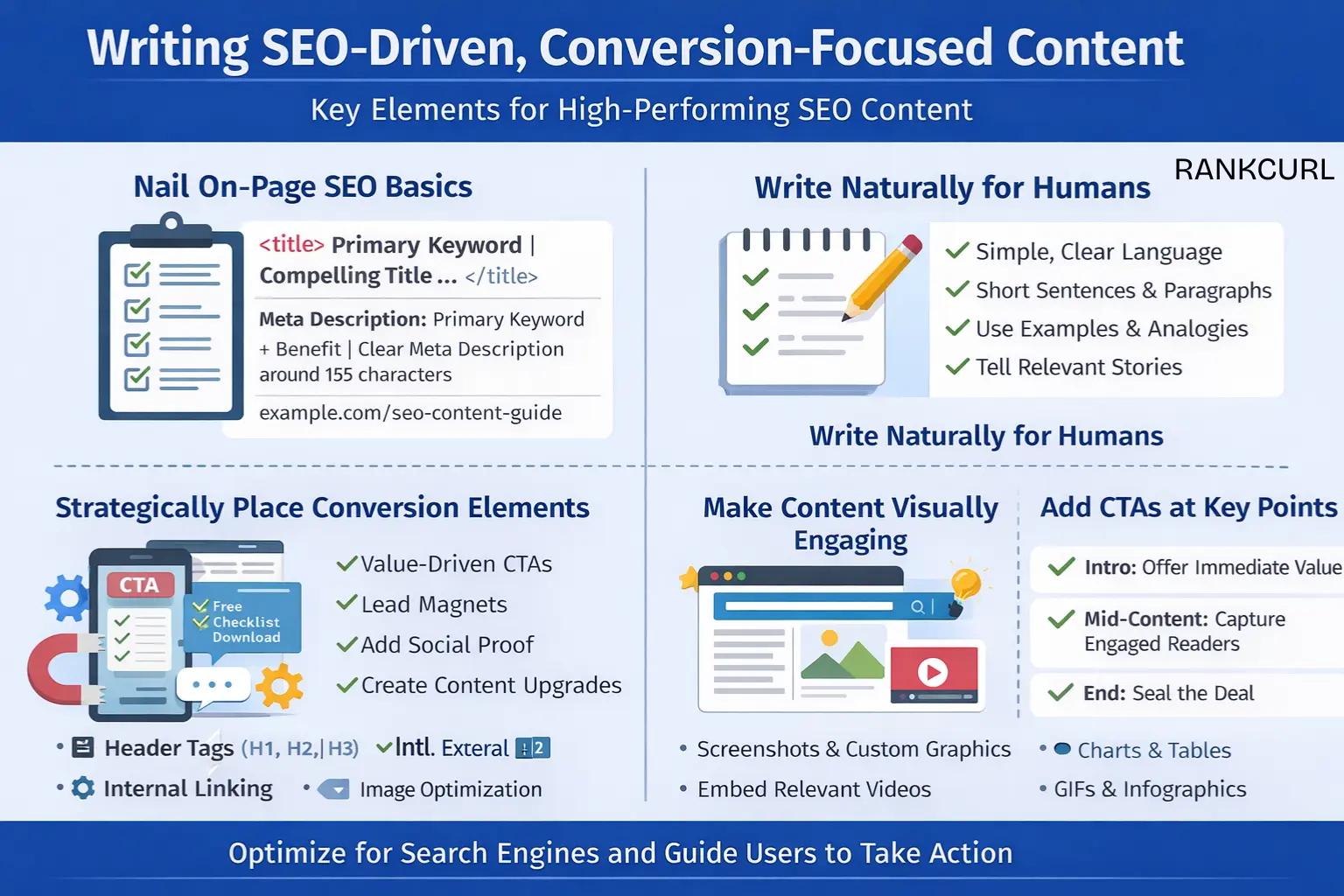
Nail the On-Page SEO Basics
These fundamentals still matter:
Title Tag: Include your primary keyword naturally. Keep it under 60 characters. Make it compelling—this is what people see in search results.
Meta Description: While not a ranking factor, it affects click-through rates. Include your keyword and a clear benefit. Keep it around 155 characters.
Header Tags (H1, H2, H3): Use your primary keyword in the H1. Include related keywords and LSI terms in H2s and H3s naturally.
URL Structure: Keep it short, descriptive, and keyword-rich. Example: /seo-content-strategy-guide/
Internal Linking: Link to 3-5 related pages on your site. This helps with SEO and keeps users engaged longer.
External Linking: Link to 2-3 authoritative external sources. Yes, this is good for SEO—it shows you’ve done your research.
Image Optimization: Use descriptive file names and alt text. Compress images for faster loading.
Write for Humans First, Search Engines Second
Here’s the golden rule: write naturally and conversationally. Gone are the days of awkward keyword stuffing.
Google’s algorithms can now understand synonyms, context, and natural language. So write like you’re explaining something to a friend:
- Use simple, clear language
- Avoid jargon unless your audience uses it
- Keep sentences and paragraphs short
- Use examples and analogies
- Tell stories where relevant
Strategically Place Conversion Elements
Now here’s where ranking content becomes converting content:
1. Add Value-Driven CTAs (Calls-to-Action):
Don’t just say “Contact Us.” Instead:
- “Get Your Free SEO Audit” (for awareness stage)
- “Download Our Complete Checklist” (for consideration stage)
- “Start Your Free 14-Day Trial” (for decision stage)
2. Use Lead Magnets:
Offer something valuable in exchange for an email:
- Checklists
- Templates
- eBooks
- Free tools or calculators
- Webinars
3. Position CTAs Strategically:
- One in the introduction (for those already convinced)
- One mid-content (for those getting value)
- One at the end (for those who read everything)
- Sidebar or sticky CTAs for visibility
4. Add Social Proof:
Include testimonials, case studies, client logos, or statistics that demonstrate results. Social proof removes hesitation and builds trust.
5. Create Content Upgrades:
Offer bonus content related specifically to that article. For example, if you’re writing about email marketing, offer an “Email Template Swipe File” as a download. These convert incredibly well because they’re highly relevant.
Make It Visually Engaging
Don’t just write walls of text. Add:
- Screenshots: Especially for how-to guides
- Custom graphics: Infographics, charts, process diagrams
- Videos: Embed relevant YouTube videos or create your own
- GIFs: For showing processes or adding personality
- Tables: For comparisons and data presentation
Visual content increases engagement time, which is a positive ranking signal, and also improves conversion rates by making your content easier to consume.
Step 5: AI and Automation in Content Strategy
Let’s address the elephant in the room: AI content tools like ChatGPT, Jasper, and others.
Use AI Responsibly
AI can be a powerful assistant, but it shouldn’t replace human creativity and expertise. Here’s how to use it effectively:
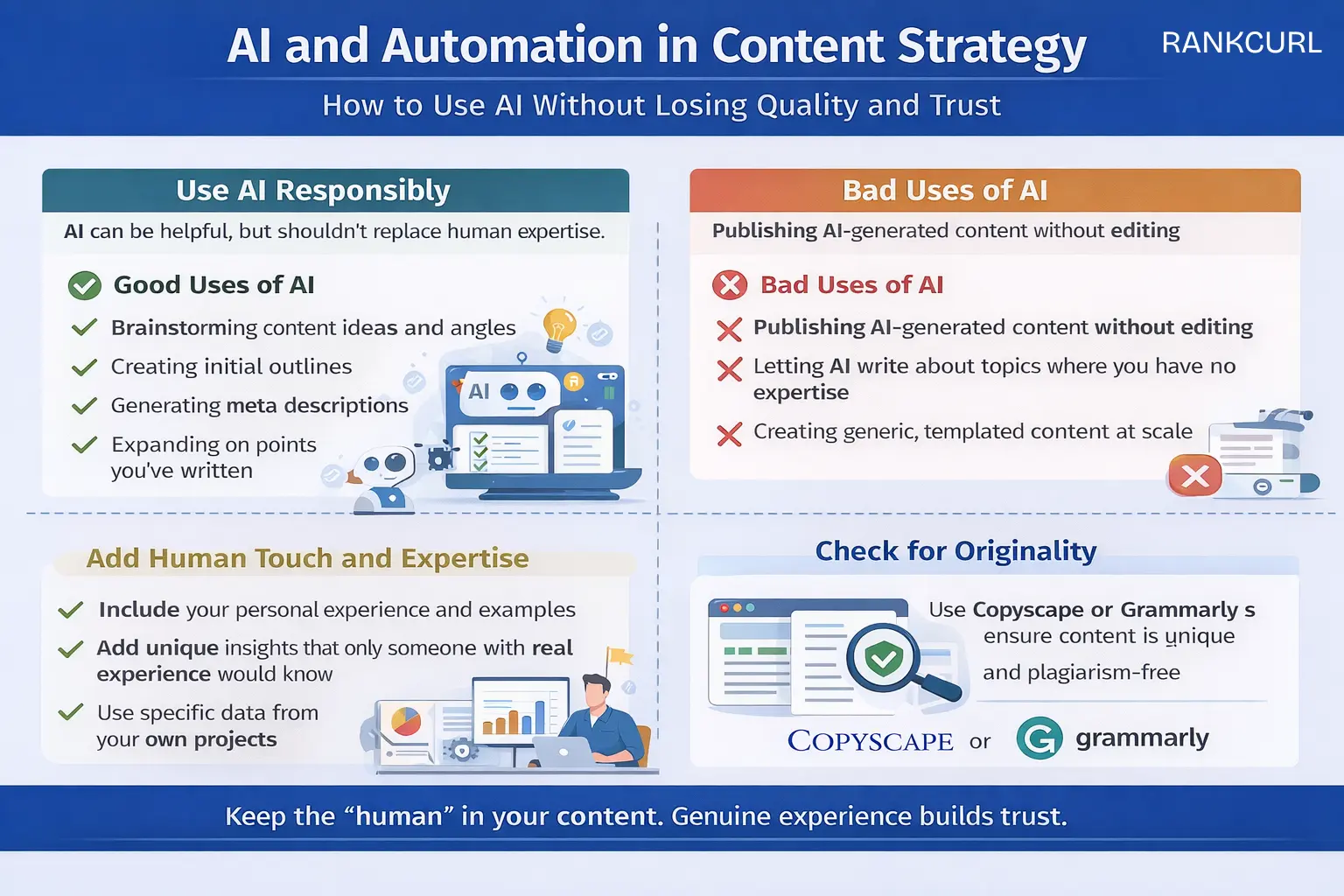
Good uses of AI:
- Brainstorming content ideas and angles
- Creating initial outlines
- Generating meta descriptions
- Expanding on points you’ve written
- Proofreading and grammar checks
Bad uses of AI:
- Publishing AI-generated content without editing
- Letting AI write about topics where you have no expertise
- Creating generic, templated content at scale
Add Human Touch and Expertise
Google has explicitly stated that they reward content demonstrating genuine experience and expertise. Here’s how to add that:
- Include your personal experience and examples
- Add unique insights that only someone with real experience would know
- Use specific data from your own projects
- Include screenshots from your own work
- Write in your natural voice, not generic corporate speak
Check for Originality
Use tools like Copyscape or Grammarly’s plagiarism checker to ensure your content is original. Even unintentional similarity to existing content can hurt your rankings.
Step 6: Content Promotion and Distribution
Creating great content is only half the battle. You need to actively promote it.
Build Links Naturally
High-quality backlinks remain one of the top ranking factors. Here’s how to earn them:
1. Create Link-Worthy Content:
- Original research and data
- Comprehensive guides
- Free tools or resources
- Unique insights or controversial takes
2. Outreach to Relevant Sites:
- Find sites linking to similar content
- Reach out with personalized emails
- Offer your content as a resource
3. Guest Posting:
- Write for reputable blogs in your industry
- Include natural links back to your content
4. Digital PR:
- Share newsworthy content with journalists
- Use platforms like HARO (Help A Reporter Out)
Leverage Multiple Channels
Don’t rely solely on organic search:
Social Media: Share your content on LinkedIn, Twitter, Facebook, Instagram—wherever your audience hangs out. Repurpose content into multiple formats (carousels, short videos, infographics).
Email Marketing: Send your content to your email list. Your subscribers are your most engaged audience.
Communities: Share in relevant Reddit communities, Quora, Facebook groups, or Slack channels—but add value, don’t just spam links.
Paid Promotion: Consider boosting your best content with Google Ads or social media ads to jumpstart traffic and links.
Repurpose Content
One blog post can become:
- A YouTube video or explainer
- A podcast episode
- An infographic
- A carousel for LinkedIn/Instagram
- A Twitter thread
- An email newsletter series
This multiplies your reach without creating everything from scratch.
Step 7: Measuring Success and Iterative Improvement
You can’t improve what you don’t measure. Set up proper tracking from day one.
Key Metrics to Track
For Rankings:
- Keyword positions (use Ahrefs, SEMrush, or Google Search Console)
- SERP features you’re appearing in
- Click-through rates from search results
For Traffic:
- Organic sessions
- Pages per session
- Average time on page
- Bounce rate
For Conversions:
- Conversion rate (leads, sales, sign-ups)
- Goal completions in Google Analytics
- Form submissions
- Email sign-ups
- Revenue attributed to organic content
Use the Right Tools
Google Analytics 4: Track traffic, user behavior, and conversions. Set up custom events for specific actions.
Google Search Console: See what queries you’re ranking for, your average positions, and click-through rates.
Heatmap Tools (Hotjar, Crazy Egg): See how users interact with your content—where they click, how far they scroll.
Conversion Tracking: Set up proper goal tracking or use platforms like HubSpot, Marketo, or your CRM to track leads from specific content pieces.
Implement a Content Refresh Strategy
Content isn’t “publish and forget.” Top-performing content needs regular updates:
Every 6-12 Months:
- Update statistics and data
- Add new sections on emerging trends
- Refresh outdated examples or screenshots
- Improve or add visuals
- Strengthen CTAs based on what’s converting
When to Refresh:
- When rankings drop
- When content becomes outdated
- When you get new data or case studies
- When competitors publish better content
Refreshed content often sees ranking improvements within weeks because Google values freshness.
Real-World Example: How This Strategy Works
Let me share a quick case study to bring this all together:
A B2B SaaS company selling project management software wanted to rank for “project management best practices.”
What they did:
- Research: They analyzed top 10 competitors and found most content was generic theory. Gap identified: no real-world implementation examples.
- Content Creation: They created a 3,500-word guide including their unique “5-Phase Project Management Framework” with real case studies from their customers, screenshots from their tool, and a downloadable template.
- Optimization: They optimized for primary keyword and related terms, added internal links to product pages, and included comparison tables.
- Conversion Elements: They added a CTA midway through offering a “Free Project Template Pack” (lead magnet) and another at the end offering a product demo.
- Promotion: They promoted via LinkedIn, sent to email subscribers, and did outreach to 20 project management blogs (got 5 backlinks).
Results after 6 months:
- Ranked #3 for primary keyword
- 2,500 monthly organic visitors
- 18% conversion rate on the template download (450 new leads/month)
- 40 of those leads converted to paid customers
That’s the power of content that both ranks and converts.
Latest Trends You Can’t Ignore in 2026
Before we wrap up, here are critical trends shaping SEO content strategy right now:
1. Search Generative Experience (SGE): Google’s AI-powered search summaries are changing the game. Focus on being cited as a source by creating authoritative, well-researched content.
2. Video Integration: Video content is appearing more in search results. Consider adding video versions of your content or embedding relevant YouTube videos.
3. Topic Authority Over Individual Keywords: Google rewards sites that comprehensively cover topics. Build content clusters and interlink heavily.
4. User Experience Signals: Core Web Vitals (page speed, interactivity, visual stability) impact rankings. Ensure your site loads fast and functions smoothly.
5. Authentic Voice: With AI flooding the internet with generic content, authentic, personal, experience-driven content stands out more than ever.
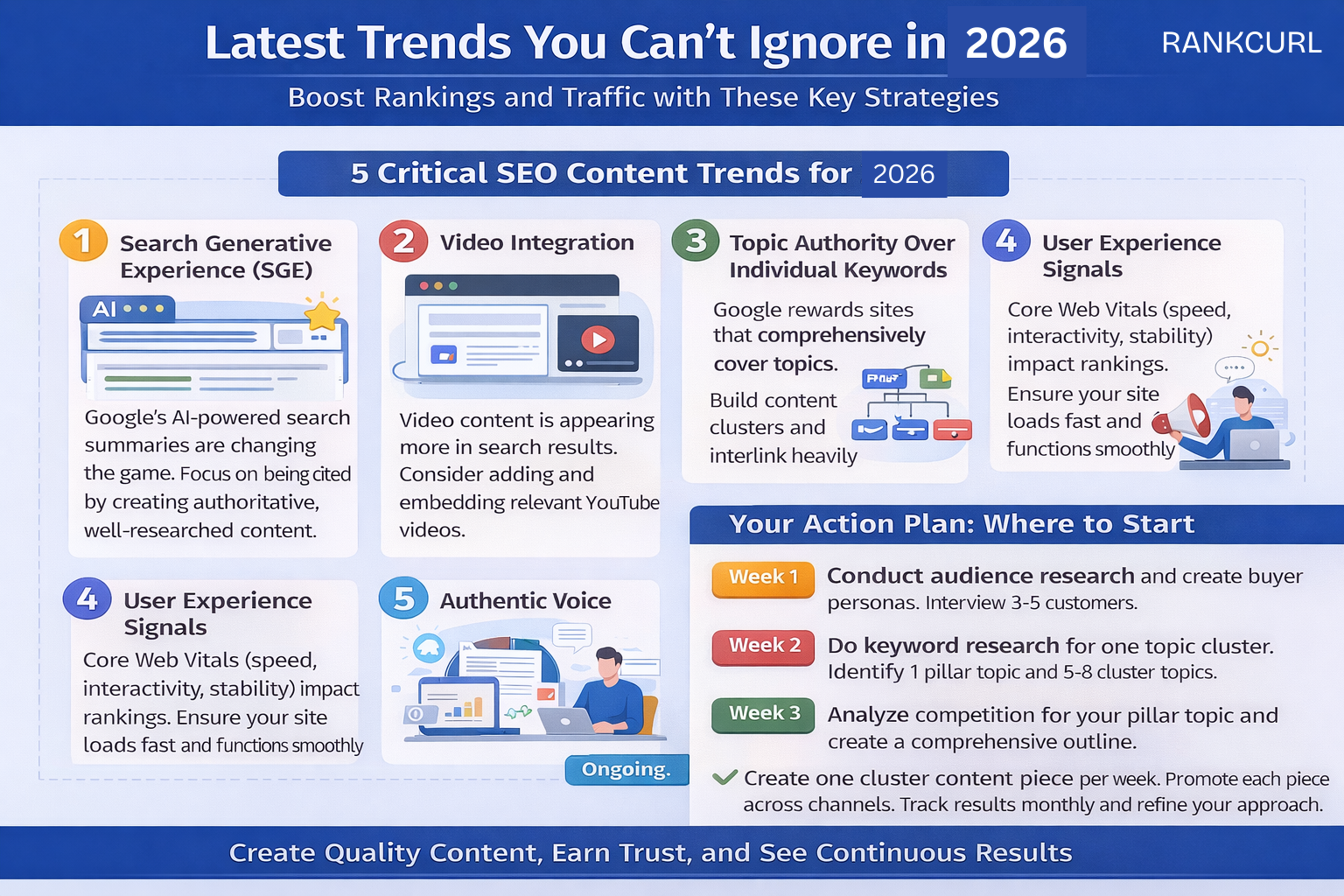
Your Action Plan: Where to Start
Feeling overwhelmed? Here’s your step-by-step action plan:
Week 1: Conduct audience research and create buyer personas. Interview 3-5 customers.
Week 2: Do keyword research for one topic cluster. Identify 1 pillar topic and 5-8 cluster topics.
Week 3: Analyze competition for your pillar topic and create a comprehensive outline.
Week 4: Write and publish your pillar content with proper on-page SEO and conversion elements.
Ongoing: Create one cluster content piece per week. Promote each piece across channels. Track results monthly and refine your approach.
Final Thoughts
A successful SEO Content Strategy is not about shortcuts. It’s about understanding your audience, delivering real value, and guiding users toward action naturally.
Yes, it takes effort. Yes, it takes time. But the results—consistent organic traffic bringing qualified leads—are absolutely worth it.
Remember: SEO is a long game, but conversions can start from day one. Focus on both, measure what matters, and keep improving.
If you need help implementing an SEO content strategy for your business, we’d love to chat. Our team specializes in creating content that doesn’t just bring traffic but actually grows your business.
Leave a Reply