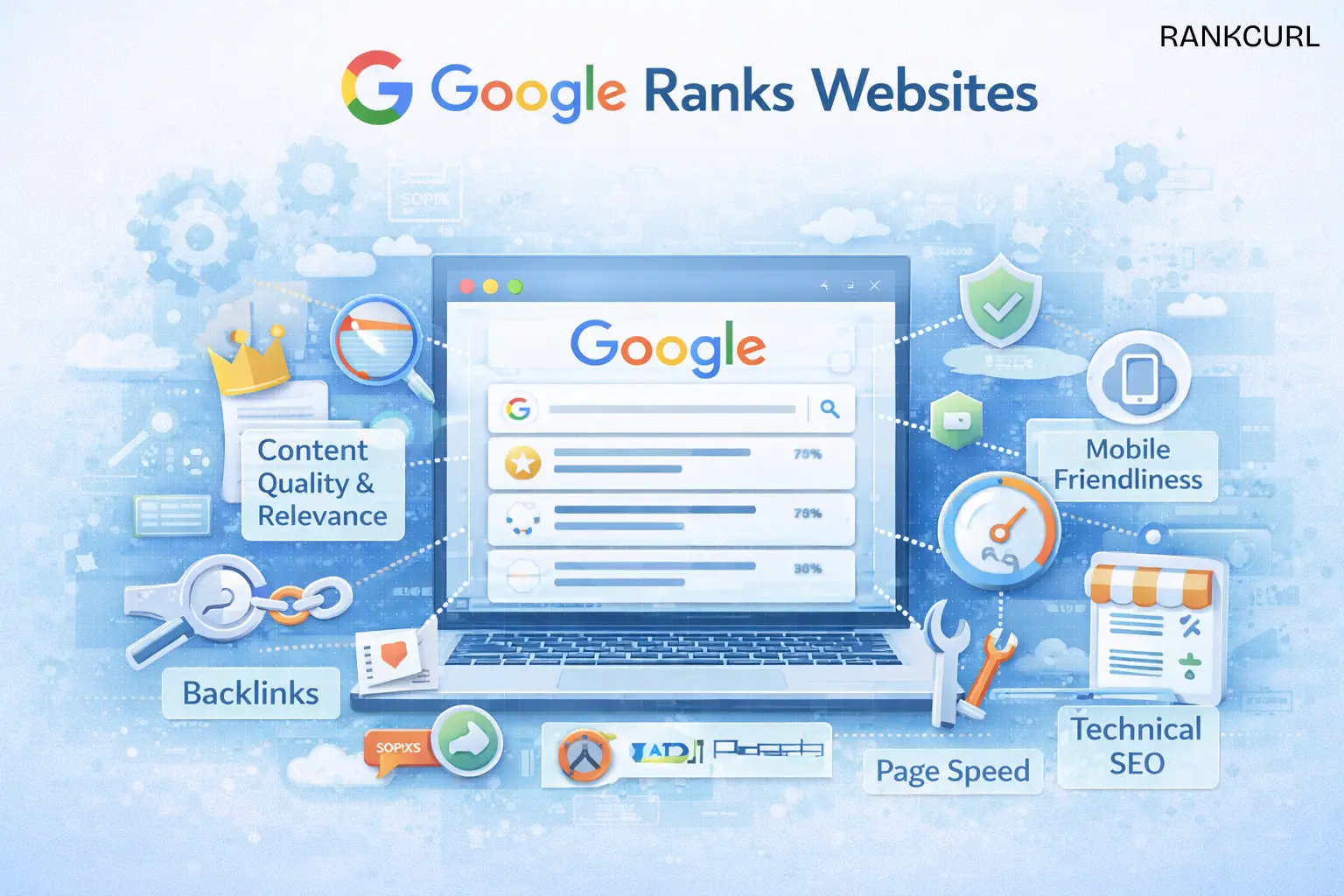
If you’ve ever wondered why some websites appear at the top of search results while others stay buried, the answer lies in how Google ranks websites.
Google’s ranking system is designed to show the most useful, relevant, and trustworthy results for every search query. It doesn’t rely on a single factor. Instead, it evaluates hundreds of signals to decide which pages deserve higher positions.
Understanding these ranking factors can help you build a website that performs better in search results and attracts consistent organic traffic.
In this guide, we’ll break down how Google ranks websites in a clear and practical way.
What Does “Ranking” Mean in SEO?
Ranking refers to the position of your webpage in search engine results for a specific keyword.
For example, if your website appears on the first page for a keyword, it is considered well-ranked. If it shows up on page three or beyond, it gets significantly less visibility.
The goal of SEO is simple: improve your rankings so that more people can find your website.
How Google Actually Works
Before understanding ranking factors, it’s important to know how Google processes websites.
Google works in three main steps:
- Crawling: Google uses bots (also known as spiders) to discover new and updated web pages.
- Indexing: Once a page is found, Google stores it in its database (index) so it can be shown in search results.
- Ranking: When someone searches, Google analyzes its index and ranks pages based on relevance and quality.
Only pages that are properly crawled and indexed can appear in search results.
Key Google Ranking Factors Explained
Let’s break down the most important factors that influence rankings in 2026.
1. Content Quality and Relevance
Content remains the foundation of SEO.
Google prefers content that:
- Clearly answers the user’s query
- Is easy to understand
- Provides real value
Thin or copied content rarely performs well. Pages that go deep into a topic and genuinely help users are more likely to rank higher.
2. Search Intent Matching
Google focuses heavily on user intent.
This means your content should match what the user is actually looking for.
For example:
- Informational searches need guides or explanations
- Transactional searches need product or service pages
If your page doesn’t match intent, it will struggle to rank even if the content is good.
3. Backlinks (Authority Signals)
local are links from other websites pointing to your site.
They act as votes of trust.
However, not all links are equal. Links from trusted and relevant websites carry more weight than random or low-quality links.
Strong backlink profiles help Google understand that your website is credible.
4. Website Experience (User Experience)
User experience plays a major role in rankings.
Google evaluates how users interact with your site.
Important factors include:
- Fast loading speed
- Mobile-friendly design
- Easy navigation
- Low bounce rate
A website that is smooth and user-friendly is more likely to rank well.
5. Page Speed and Core Web Vitals
Speed is no longer optional.
Google uses performance metrics like:
- Loading time
- Interactivity
- Visual stability
Slow websites frustrate users, which negatively affects rankings.
Optimizing speed improves both user experience and SEO performance.
6. On-Page SEO Optimization
On-page SEO helps Google understand your content better.
This includes:
- Proper use of headings (H1, H2, etc.)
- Keyword placement
- Meta tags
- Internal linking
Well-structured pages are easier for both users and search engines to read.
7. Mobile Friendliness
Most users browse on mobile devices.
Google follows a mobile-first approach, meaning it primarily uses the mobile version of your site for ranking.
If your website doesn’t perform well on mobile, your rankings will suffer.
8. Domain Authority and Trust
Websites with a strong reputation tend to rank higher.
This is built over time through:
- Consistent quality content
- Strong backlink profile
- Positive user signals
New websites can rank too, but they need to prove their value.
9. Freshness of Content
For many topics, updated content performs better.
Google prefers content that is:
- Recently updated
- Relevant to current trends
- Accurate and up-to-date
Regularly updating your content can improve rankings.
10. Technical SEO Factors
Technical SEO ensures that your website is easy for search engines to access and understand.
Important elements include:
- Clean site structure
- XML sitemap
- Proper indexing
- Fixing broken links
Without proper technical setup, even great content may not rank.
11. User Engagement Signals
Google pays attention to how users behave on your site.
Signals include:
- Click-through rate (CTR)
- Time spent on page
- Bounce rate
If users quickly leave your site, it indicates that your content may not be useful.
Common Mistakes That Hurt Rankings
Avoid these mistakes if you want better results:
- Keyword stuffing
- Duplicate content
- Buying spammy backlinks
- Ignoring mobile optimization
- Slow website performance
These issues can push your site down in rankings.
How to Improve Your Rankings
Improving rankings takes time, but the process is straightforward:
- Create helpful, high-quality content
- Focus on user intent
- Build strong backlinks
- Improve website speed and design
- Fix technical issues
Consistency is key. Small improvements over time lead to long-term growth.
Final Thoughts
Google’s ranking system may seem complex, but the core idea is simple: show users the best possible results.
If your website provides real value, is easy to use, and is trusted by others, it has a strong chance of ranking well.
Instead of chasing shortcuts, focus on building a website that genuinely helps users. That approach will always work, no matter how algorithms evolve.
Leave a Reply